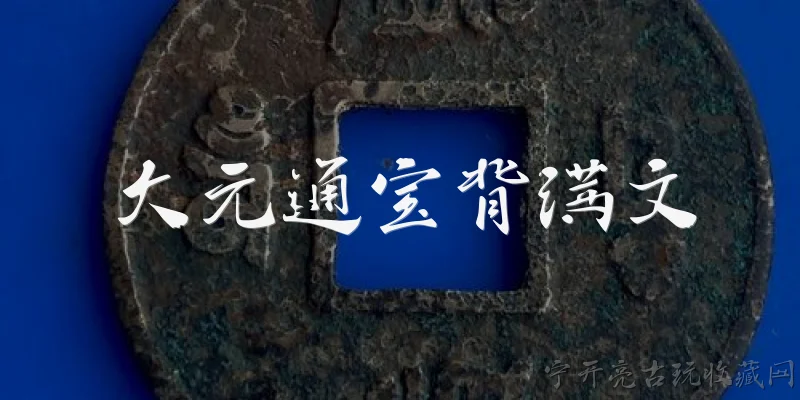
Dayuan Tongbao with Manchu script on reverse:What is a Dayuan Tongbao with Manchu script on the reverse?
Q: What is a Dayuan Tongbao with Manchu script on the reverse?
A: A Dayuan Tongbao with Manchu script on the reverse is a distinct type of ancient Chinese coin that combines two different cultural elements. The obverse typically bears the Chinese characters 'Dayuan Tongbao' in regular script, indicating its era name and status as a circulating currency. The reverse, however, features Manchu script, which was used by the Qing dynasty. This combination is unusual because the Dayuan era name was used by the Mongol-led Yuan dynasty, while Manchu script is associated with the later Qing dynasty. Such coins are often considered either later restrikes, fantasy pieces, or commemorative issues made during the Qing period to honor the Yuan legacy. They are not standard currency from the Yuan dynasty itself, but rather a numismatic curiosity that reflects the complex interplay of Chinese and Manchu cultural influences in later periods.
Q: When and why were Dayuan Tongbao coins with Manchu reverse script produced?
A: Dayuan Tongbao coins with Manchu script on the reverse were not produced during the Yuan dynasty (1271–1368), when the Dayuan Tongbao was originally issued. Instead, they likely appeared during the Qing dynasty (1644–1912), when Manchu script was the official script for coin reverses. The reason for their production is debated. Some scholars suggest they were made as commemorative or temple coins, perhaps to honor the Yuan dynasty's legacy or for use in specific rituals. Others believe they are later fantasy pieces created for collectors. Another possibility is that they were struck by local mints during the Qing period that mistakenly or intentionally combined an old era name with contemporary Manchu script. Regardless, these coins are rare and serve as a fascinating example of how historical coinage can be reinterpreted across different dynasties.
Q: How can you identify an authentic Dayuan Tongbao with Manchu script on the reverse?
A: Identifying an authentic Dayuan Tongbao with Manchu script on the reverse requires careful examination. First, check the obverse: authentic Dayuan Tongbao coins from the Yuan dynasty typically have broad rims and a distinct calligraphy style, often with a deep patina. However, if the reverse has Manchu script, the coin is almost certainly not from the Yuan dynasty. Look at the Manchu script itself—it should match the style used on Qing dynasty coins, such as those from the Shunzhi, Kangxi, or Qianlong reigns. The metal composition should also be consistent with Qing coinage, usually brass or bronze with a specific alloy. Casting quality, wear patterns, and the presence of tool marks can help distinguish authentic pieces from modern fakes. Consulting reference catalogs like 'Zhongguo Guqian Dacidian' and seeking expert authentication is advisable, as many such pieces are modern reproductions.
Q: What is the historical significance of a Dayuan Tongbao with Manchu script on the reverse?
A: The historical significance of a Dayuan Tongbao with Manchu script on the reverse lies in its role as a cultural hybrid. The Dayuan Tongbao was originally issued by the Yuan dynasty, a Mongol-led empire that used Chinese-style coinage but also relied on paper currency. Manchu script, on the other hand, was created in the early 17th century and became the official script of the Qing dynasty. A coin bearing both elements suggests a later period when Qing authorities or local mint workers sought to connect with the Yuan legacy, perhaps to legitimize their rule or to appeal to Mongol subjects. It also highlights the continuity and adaptation of Chinese coinage traditions across dynasties. While not a standard historical currency, such a coin serves as a tangible artifact of cross-cultural exchange and the complex identity of the Qing empire, which ruled over diverse peoples including Mongols, Han Chinese, and Manchus.
Words of experience
Common scenarios of "Dayuan Tongbao with Manchu script on reverse"
【Coin Collector】 I recently acquired a Dayuan Tongbao coin with Manchu script on the reverse. I'm curious about its origins.
【Numismatist】 That's interesting! The Dayuan Tongbao was issued during the Yuan Dynasty, but the Manchu script on the reverse suggests it might be from the Qing Dynasty instead. Could you describe the coin more?
【Coin Collector】 The obverse has 'Dayuan Tongbao' in Chinese characters, and the reverse has Manchu script on the left and right, with a Chinese character '元' in the center.
【Numismatist】 Ah, that's a key detail. The presence of Manchu script indicates it's likely a Qing Dynasty coin, possibly from the reign of Emperor Xianfeng or later. The '元' might refer to a mint or a specific denomination.
【Coin Collector】 But why would a Qing coin have 'Dayuan Tongbao'? That seems contradictory.
【Numismatist】 Good question. In the Qing Dynasty, some coins were issued with old titles for various reasons, like commemorative issues or local minting. Also, 'Dayuan' could be a mint name. The Manchu script usually indicates the mint and the reign title.
【Coin Collector】 So the Manchu script on the left and right likely spells out the mint name?
【Numismatist】 Exactly. Typically, the left Manchu word is 'Boo' meaning 'treasure', and the right is the mint name, like 'Ciowan' for the Board of Revenue. So it would read 'Boo Ciowan' if it's from the central mint.
【Coin Collector】 I see. But the Chinese character '元' in the center is unusual. Could it be a misstrike or a later addition?
【Numismatist】 It might be a mint mark or a symbol. Some Qing coins have Chinese characters on the reverse indicating the mint or value. '元' could mean 'yuan' as in a denomination, but that's rare. It could also be a local mint's mark.
【Coin Collector】 Are there known varieties of Dayuan Tongbao with Manchu script?
【Numismatist】 Yes, there are a few. For example, during the Xianfeng period, some coins were issued with 'Dayuan Tongbao' as a tribute to the Yuan Dynasty, but with Manchu script for practical use in the Qing administration. These are quite rare and sought after.
【Coin Collector】 That makes sense. How can I determine its authenticity and value?
【Numismatist】 You should check the weight, diameter, and metal composition. Authentic Qing coins have specific standards. Also, consult a reputable numismatic catalog or an expert. The value depends on rarity and condition; these can range from a few hundred to several thousand dollars.
【Coin Collector】 I'll do that. Are there any online resources you recommend?
【Numismatist】 Websites like Numista or the Chinese Coinage Forum are great. Also, books like 'The Standard Catalog of Chinese Coins' by Krause are helpful. Just be cautious of forgeries.
【Coin Collector】 Thanks for the advice. I'll have it appraised. One last question: why is the Manchu script on the reverse instead of the obverse?
【Numismatist】 In Qing coinage, the obverse typically has the Chinese reign title, while the reverse has Manchu script to indicate the mint. This was standard to facilitate communication between the central government and Manchu officials. So it's not unusual.
【Coin Collector】 That clarifies a lot. I appreciate your help!
【Numismatist】 You're welcome! Enjoy your collecting journey. If you find more, feel free to ask.